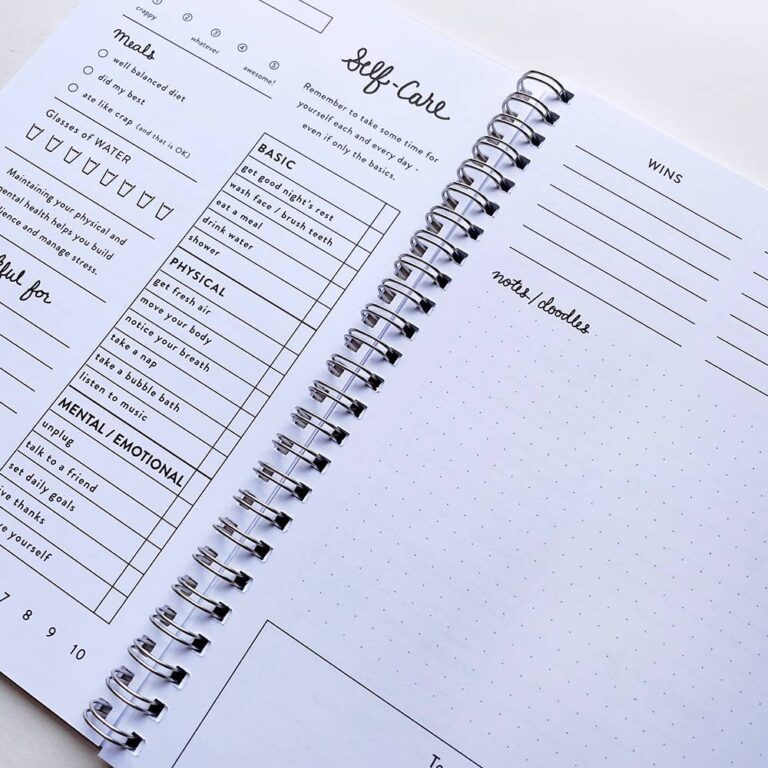

Gratitude Journal: Transform Your Mindset in 5 Steps
If you’re searching for a way to improve your mood, deepen joy, and build mental resilience, a Gratitude Journal might be exactly what you need.
Most articles you’ll find cover the basics: what gratitude journaling is, a few prompts, and maybe a list of benefits.
But what’s often missing is the how-to structure for consistency, coping with hard times, linking gratitude with other journaling types (like sleep, stress, goals), plus ways to personalize the practice so it stays meaningful long-term.
This post fills in those gaps. We’ll give you:
- What makes gratitude journaling powerful (science + mental health)
- How to start (best times, formats, mindset)
- A 30-day practice plan + examples
- Deep gratitude prompts (for bad days, ordinary days, growth)
- Ways to personalize & combine with other journals for maximum impact
Let’s dive in.
What is Gratitude Journaling & Why It Matters
Gratitude journaling means regularly writing down things you’re thankful for. Not just big events, but small moments: a kind message, a warm cup of coffee, a sunny morning.
Key Benefits backed by research
- Improves mental health: reduces anxiety, depression, improves mood.
- Enhances resilience: helps you see lessons even in tough times.
- Better sleep when done near bedtime.
- Boosts self-esteem: recognizing your own strengths and what you have.
Many posts mention “feel-good” effects, but few explain how gratitude changes your brain: it drives the brain to record positive neural pathways, counteracting negativity bias. Also, the benefits aren’t instant; consistency matters.
What Most Competitor Posts Miss (Gaps You Should Fill)
From surveying top posts (Calm, Mindful Living, Gratitude Gifted, journal hubs) here’s what they often don’t emphasize much:
- Hard days / heavy emotions — when gratitude feels forced or trivial. How to do gratitude even during grief, stress, transitions.
- Linking gratitude with other journal types — using gratitude to strengthen goal-journal, affirmations, sleep, etc.
- Habit formation & sustainability — routines, habit-stacking, making journaling easy.
- Visual or multimodal journaling — combining drawing, photos, voice, digital + analog.
- Reflection & review — revisiting past entries, seeing growth over time.
This article will cover all those so you’ll not only start journaling, but make it transformative and sustainable.
Step 1: How to Start Your Gratitude Journal the Right Way
Choose your format
- Physical notebook vs app vs digital document (Notion, Google Docs). Choose what you’ll stick with.
- Decide on structure: simple list, prompts, mix with drawing or photos.
- Set a realistic practice frequency: daily is great, but even 3-4 times/week makes a difference.
Pick timing & environment
- Morning: helps set positive tone for the day.
- Evening: reflect on what happened; helps sleep and mindset.
- Choose a quiet place; remove distractions.
Mindset tips for real, heartfelt entries
- Be specific. (“My sister’s text,” not “my family.”)
- Avoid comparison. Gratitude is about your life, not someone else’s.
- Journal honestly. Include tough feelings too—gratitude doesn’t mean ignoring hardship.
- Use senses: what did you see, smell, feel, hear?
Step 2: A Sample 30-Day Gratitude Practice Plan
Here’s a schedule to build the habit — includes prompts for ordinary, tough, and growth days.
| Day | Focus | Prompt Example |
|---|---|---|
| 1 | Simple mornings | Three small things you noticed this morning |
| 2 | People | Someone you admire + why |
| 3 | Growth | A challenge you learned from recently |
| 4 | Nature | Something in nature that calms you |
| 5 | Self | One thing you like about yourself |
| 6 | Reflection | Best part of your week so far |
| 7 | Hard day | Something that surprised you / helped you through the day |
| 8 | Sensory | A smell, sound, or texture you were grateful for |
| 9 | Past | Favorite childhood memory |
| 10 | Future | Something you’re looking forward to |
| 11 | Ordinary day | A routine you’re thankful for |
| 12 | People | A kindness someone showed recently |
| 13 | Self-care | A small act of self-care you did |
| 14 | Growth | A failure that taught you something |
| 15 | Gratitude letter | Write a letter (you may not send) to someone who helped you |
| 16 | Nature | A place that brings you peace |
| 17 | Sensory | Favorite meal / smell / taste |
| 18 | Self | Quality you possess that you value |
| 19 | Hard day | What kept you going today |
| 20 | Reflection | What changed over past two weeks? |
| 21 | Ordinary | A small win you barely noticed |
| 22 | People | Someone you haven’t thanked lately |
| 23 | Growth | Something about yourself you are proud of |
| 24 | Future | Something you wish to learn or try |
| 25 | Nature | Rings you joy from outside environment |
| 26 | Self-compassion | Something you forgive yourself for or accept |
| 27 | Gratitude for challenge | A past hardship that led to strength |
| 28 | Ordinary day | Favorite object / item around you |
| 29 | Relationships | A quality in someone you love |
| 30 | Big picture / Vision | What kind of life you want + what you already have that supports it |
At the end of each week, take 5 minutes to review your entries: see themes, notice growth, decide what to carry forward.
Step 3: Prompts to Use Anytime (Especially When You Don’t Know What to Write)
Here are deep prompts, categorized, so you always have something to write when you feel stuck.
Light / Everyday Prompts
- What’s a small moment today that made you smile?
- What senses did you enjoy today (smell, taste, touch, sight)?
- Name one thing in your home you’re grateful for.
- What is something ordinary that felt special?
Growth & Change Prompts
- What have I become stronger through?
- What is a skill or quality I developed this month?
- In what ways has a past failure served me later?
Hard Day / Tough Emotion Prompts
- What helped me even a little today?
- What is one thing I can appreciate about this moment, even if everything else feels hard?
- How have challenges shaped me rather than broken me?
Relationship / Other-People Prompts
- Who’s someone I often take for granted? What do I appreciate about them?
- What did someone do that I usually overlook?
- What qualities in others inspire me?
Future / Goals / Vision Prompts
- What are small signs I’m heading toward my goal?
- What dreams or aspirations feel alive right now?
- How can being grateful now set up better tomorrow?
Step 4: Combining Gratitude with Other Journals for Deeper Impact
To make your gratitude practice more than just “write-nice-things,” tie it with other journal types. This kind of integration is rare in competitors, but powerful.
- Sleep Journal: note what you’re grateful for before bed → better sleep, fewer worries.
- Mood Tracker: track your mood as well as gratitude entries; find correlations (e.g., low mood + missed gratitude).
- Goal Journal / Vision Journal: gratitude entries often point to what matters most; use them to clarify values and goals.
- Affirmations Journal: turn gratitude into affirmation (e.g., “I am capable,” “I appreciate my resilience”)
- Stress / Health Journals: gratitude supports stress relief; on difficult health days, gratitude entries may help reduce perceived suffering.
Step 5: Sustaining & Personalizing Your Gratitude Practice
Habit tips
- Anchor to a routine (after brushing teeth, with morning coffee, just before bed).
- Use habit stacking: attach journaling to an existing habit.
- Use reminders (alarms, sticky notes).
- Make it easy: limit time (5-10 minutes), keep your journal handy.
Personalization
- Use visuals: photos, drawings, doodles.
- Try voice notes or audio journaling if writing feels heavy.
- Mix formats: some days lists, others full entries, others letters.
- Color code entries (e.g., green for growth, blue for hard days) to see patterns visually.
Review & reflection
- Monthly review: re-read past 30 days, note recurring themes.
- Yearly summary: biggest surprises, lessons, things to carry forward.
- Gratitude maps: cluster entries by person, place, quality (who/what you’re thankful for).
Science + Psychology Behind Gratitude Journals
To deepen your confidence in this practice, it helps to know why it works. These are insights many competitors mention, but often only briefly:
- Neuroplasticity: our brain forms patterns; focusing on gratitude weakens the “negativity bias” (the tendency to notice bad more than good).
- Stress hormone reduction: gratitude can reduce cortisol levels, easing stress & improving wellness.
- Sleep quality: gratitude just before sleep is linked to fewer nightmares, less rumination, better rest.
- Improved social connection: expressing gratitude (even in journal-form or to others) strengthens relationships.
Examples: Real Entries
Here are sample gratitude journal entries to show you what real writing can look like. Use them for inspiration, not comparison.
Entry A – Ordinary Day
“Today I’m grateful for the warm sun through my window in the morning – the way it lit up my desk. For the sound of my neighbor’s dog barking happily, reminding me life continues outside. For the mug of chai I drank while reading – that small ritual carried comfort.”
Entry B – Hard Day
“Today was hard: I felt overwhelmed at work, frustrated with delays. I’m grateful for my coworker who listened, even though they were busy. Grateful I paused, breathed, and took a walk. Grateful for the reminder that difficult days don’t erase every good thing.”
Entry C – Growth Reflection
“Looking back over this week, I’m grateful that I tried something new — spoken up in a meeting. Even though my voice shook, I did it. I’m grateful for the courage I found, and that this challenge is teaching me resilience.”
FAQ: Common Questions & Misconceptions
| Question | Answer |
|---|---|
| Do I have to write every day to benefit? | No. Even 3-4 times per week helps. Consistency over perfection. |
| What if I can’t think of anything to write (blank mind)? | Use prompts above; focus on small things; even one line is enough. Reflect on senses, routine, or what moment felt light. |
| Isn’t gratitude journaling “toxic positivity”? | Not if you allow space for real experiences. Acknowledge hard feelings, then also notice what you still appreciate. It’s not ignoring; it’s balancing. |
| How long should entries be? | No set rule. Five minutes, one sentence, or longer reflection—whatever feels sustainable. |
| Digital vs physical? | Both work. Physical can feel more tangible; digital easier for prompts, reminders, portability. Choose what you’ll do, not what seems perfect. |
Putting It All Together: Your First Week Blueprint
Here’s a tighter plan just for your first 7 days to get momentum:
| Day | When | What to Write |
|---|---|---|
| Day 1 | Morning | 3 simple gratitudes: sights/sounds |
| Day 2 | Evening | Best part of the day + what you learned |
| Day 3 | Morning | Person you appreciate + action you can take to show appreciation |
| Day 4 | Evening | Hard moment + something good that came along |
| Day 5 | Morning | A routine or small thing you often overlook |
| Day 6 | Evening | One thing you accomplished (big or small) you’re proud of |
| Day 7 | Morning | Reflect: what recurring themes appeared? What surprised you? |
Final Thoughts
A Gratitude Journal isn’t about perfection. It’s about noticing, remembering, and shifting your mindset bit by bit. When done regularly, even small entries carry power.
You’ve now got:
- Why gratitude journaling works (science + emotional health)
- How to begin with structure, mindset, habit formation
- Deep, varied prompts including for painful days
- Ways to combine gratitude with sleep, goals, affirmations, stress, growth
- Personalization tools so this isn’t just another ticking box
Start with what feels easiest. Celebrate small consistency. Over time, the gratitude practice won’t just be something you do—it becomes part of who you are.